
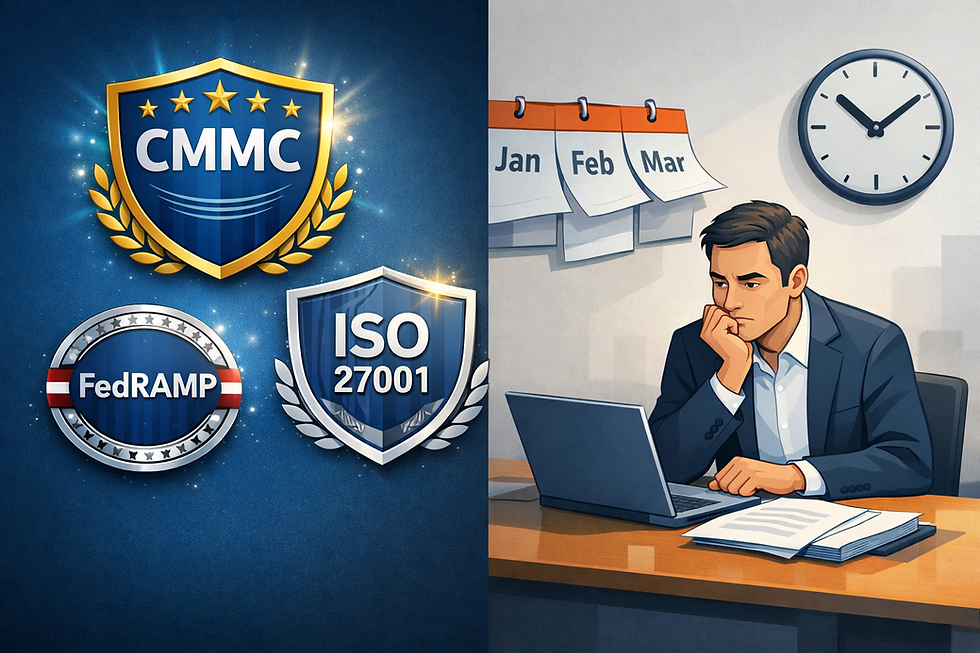
Before You Chase That Certification, Ask These Questions
10 Feb 2026
Government contractors love certifications. CMMC, FedRAMP, ISO 27001, StateRAMP. If there's an acronym and a compliance framework, someone's probably telling you that you need it.
And maybe you do. But probably not yet.
The problem with certifications is that they feel productive. They sound impressive in proposals. They look good on your website. They give you something concrete to work toward when sales are slow or you're not sure what else to do.
But they're expensive. They take months (sometimes years). And if you pursue the wrong one at the wrong time, you've just burned a ton of cash and energy on something that doesn't move the needle.
So before you write that check or start that process, here are the questions you actually need to answer.
Is Anyone Actually Asking for It?
Not "might they ask for it someday." Not "it would probably be good to have."
Are real customers with real contracts explicitly requiring this certification?
If you're losing deals and the feedback is "we need you to have X certification," that's signal. If you're assuming that's why you lost, or you think it'll help but nobody's mentioned it, that's noise.
The distinction matters because certifications are expensive insurance policies. You don't buy insurance for problems you don't have.
Can You Validate Demand Before You Commit?
Talk to your existing customers. Talk to prospects. Talk to partners.
Ask them directly: "If we had [certification], would that change anything for you?"
Listen to how they answer. "Oh yeah, that would be huge" is different from "I mean, it couldn't hurt." One justifies the investment. The other doesn't.
And if you're early-stage or pre-revenue, be brutally honest about whether you're pursuing this because the market needs it or because you need to feel legitimate.
What's the Actual ROI?
Certifications aren't cheap. CMMC can run $50K-$150K depending on your level. FedRAMP starts around $100K and goes up from there. ISO 27001 is somewhere in between.
And that's just the direct cost. You've also got:
Engineering time to implement required controls
Documentation and audit preparation
Ongoing compliance maintenance
Opportunity cost of what else you could be building or selling
So what's on the other side of that investment?
Specific contracts you can't bid on without it? Partnership opportunities that require it? A competitive advantage that translates to revenue?
If you can't draw a straight line from certification to dollars, you're not ready.
Do You Have the Runway?
Certifications take time. FedRAMP can take 10 months or more. CMMC timelines vary but aren't quick.
If you're burning cash and hoping the certification will unlock enough revenue to save you before you run out of money, you're in trouble. Certifications should be offensive moves, not Hail Marys.
Are Your Competitors Doing It?
This one cuts both ways.
If none of your competitors have a particular certification, that could mean it's not actually important in your market. Or it could mean there's a huge opportunity to differentiate.
If all of your competitors have it, you might be behind. Or you might be smarter than them for not wasting the money yet.
The point isn't to copy what everyone else is doing. The point is to understand why they are or aren't pursuing it and whether that logic applies to you.
What Problem Are You Actually Solving?
Certifications don't make bad products good. They don't create value where none exists.
If your pitch is "we're compliant" instead of "we solve this specific pain point," you've got bigger problems than missing certifications.
Compliance should be an enabler, not the product. It should unlock access to customers who already want what you're selling, not be the reason they buy.
The Bottom Line
Certifications matter. In government contracting, they often matter a lot but they're not magic. They're not shortcuts. And they're definitely not substitutes for product-market fit or real customer demand.
Before you pursue any certification, make sure you can answer these questions honestly:
Who's asking for it, specifically?
What revenue or partnerships does it unlock?
Can you afford the time and money it takes?
Are you doing this because customers need it, or because it makes you feel legitimate?
If you can't answer those clearly, you're probably not ready yet.

Cyrus Calloway
VP of Business Development at Virtual Dojo, helping government contractors and VARs win more deals.